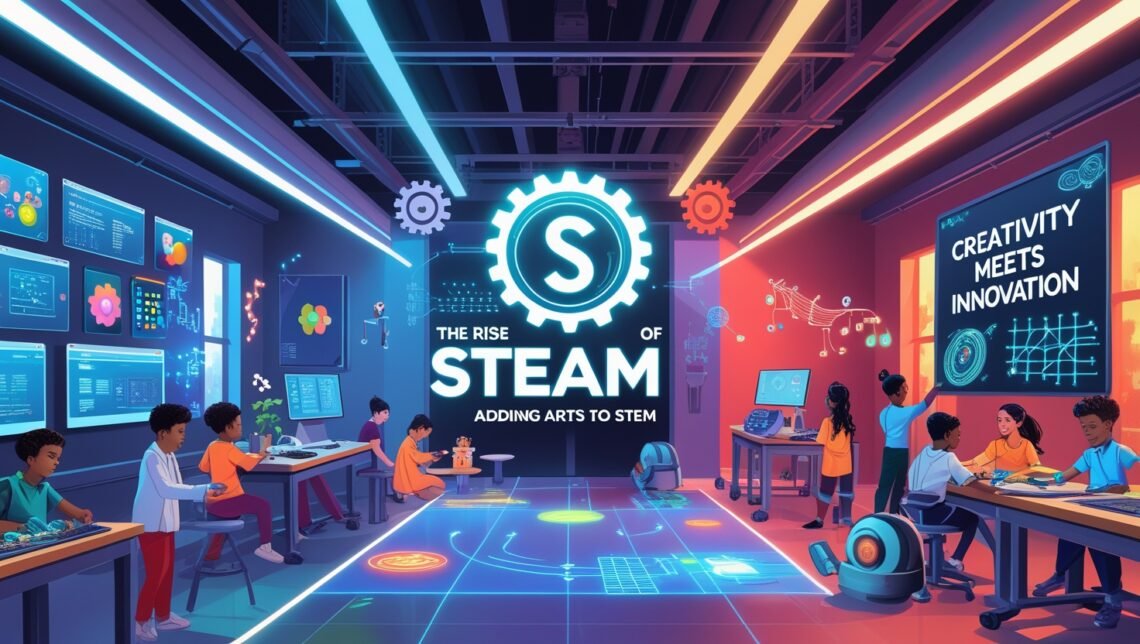
STEM means Science, Technology, Engineering, and Mathematics, and this model has been used in educational systems across the world for a long time. The focus of this model was on logical thinking, technical skills, and problem-solving, but as times are changing, new perspectives are also emerging in education. STEAM is a part of this transformation in which the Arts have been included along with STEM. This change is not just an increase in a subject but a change in an entire educational philosophy. In this, creativity, design, imagination, and expression are also being considered as important as scientific reasoning was considered. In today’s times, only scientific knowledge is enough. But it is also important to express those ideas visually and emotionally.
The aim of STEAM is that students should not only be technically skilled but should also be capable of thinking and solving problems in new ways. When we mix arts with science, we get a holistic education that prepares us for future challenges. Innovation in the modern world happens when science and creativity work together, and STEAM is the name of this fusion. Through this model, we inspire students to think from new perspectives and bring positive changes in the world.
2. The Importance of Arts in Scientific Thinking:
Arts have a very important role in scientific thinking, which was ignored earlier, but now their importance is being understood. When we talk about science and technology, we often look at formulas, numbers, and logical steps, but in reality, to understand these things, imagination and visualization are necessary, which we get from the arts. When a scientist works on a new idea, he needs not only calculations but also freedom of thinking and creativity. Arts inspire a person to go beyond their thinking and find new ways. And look at difficult problems from a new perspective.
If an engineer makes a machine, he also has to take care of the design, otherwise the machine will work but it may be difficult to use If an app developer makes software, he also has to take care of the user interface and aesthetics Arts teaches us all these skills The fusion of creativity and expression makes science more impactful and students acquire emotional intelligence along with critical thinking Therefore, when arts and science are learned together, students become more flexible, more innovative and more expressive This aspect of STEAM education develops students in a new way where they We don’t just remember the information but rather understand it and express it and look for new solutions.
3. How STEAM Prepares Students for the Future:
Today’s students cannot limit themselves to classroom knowledge. They need an education that prepares them for the challenges of the real world and brings diversity in their thinking. The STEAM model prepares future-ready students who can make their place in every field. When science and arts are combined, holistic thinking is developed in the students, in which they are logical as well as creative. Due to this combination, they do not see every problem only from a technical angle but also start understanding user experience design and social impact. Jobs of the future will not be based only on coding or mechanics.
Those industries would like their employees to also have skills such as imagination, empathy, and collaboration. STEAM education promotes these very skills in students. Another advantage is that when arts are combined with STEM, students who are interested in science are also motivated, and they too get an opportunity to learn in new ways. In this approach, projects are real-world based, where students learn teamwork, communication, and decision-making. The use of digital tools and design thinking prepares them for modern workplaces. The aim of STEAM is not just to develop academic excellence but also practical skills so that students can adapt in every field and give the world new solutions through their thinking and talent.
4. Examples of STEAM in Action:
STEAM education has been successfully implemented by many schools and organizations around the world, and its effect is visible on the creativity and performance of students. For example, some schools use a project-based learning model where students use science, technology, and arts to solve a specific problem. For example, in a project, students have to design a sustainable city where they also have to use environmental science, engineering concepts, as well as design and aesthetics.
Similarly, the concept of STEAM is also used in robotics programs where students create robots but also prepare their design, animation, and presentation. Some schools combine music and coding to create apps that simulate musical instruments or focus on visual storytelling. All these examples show how students start thinking in both creative and logical ways. Universities and companies also appreciate STEAM graduates because they have cross-disciplinary skills and can solve complex problems in an innovative way. In such programmes, students not only learn bookish knowledge but also get prepared for practical life. They also know how to visualize and implement their ideas. All this is possible through STEAM.
5. Challenges and Criticisms of the STEAM Approach:
While there are many benefits of STEAM education, there have also been some challenges and criticisms. Some people believe that by combining arts with STEM, we are reducing the depth of science and maths. They say that if students focus on multiple subjects, they cannot achieve mastery in any one field. Apart from this, it is not clear to many educators how to include arts in the STEM curriculum. They need training and resources, but not every school or teacher has those facilities. Some people also say that STEAM Projects take a lot of time and their benefits cannot be easily measured in traditional exams. This is why many institutions are hesitant to fully adopt STEAM.
But if these challenges are handled with proper planning, these problems can become opportunities. Professional development programs can be designed for teachers where they can learn STEAM integration. Curriculum designers can create modules that naturally integrate subjects and assessments also evaluate practical skills. The objective of STEAM is that students should be ready for the future. Therefore, even if there are some hurdles, they can be solved through innovation and collaboration so that a new model of education reaches every student.
6. Conclusion:
The concept of STEAM education has become a necessity of today’s time When we stick to STEM, we only develop technical skills in students, but when we include Arts as well, those students become more expressive, more collaborative and more imaginative The STEAM model tells us that education should not be limited to just numbers and theories, but it should also include design, music, storytelling and empathy This approach covers every field, be it engineering or medicine or business or communication When students learn to think from multiple angles, they can solve every problem creatively in real life World of the future It will be such a place where innovation, creativity and emotional intelligence will all be required together and STEAM education prepares students for that future. If we adopt the vision of STEAM in schools, colleges, and universities, we will prepare such a generation which will not only be academically brilliant but will also be socially responsible and emotionally aware, and this will be the real future of balanced learning where science and art become each other’s support and allow every student to grow completely.
FAQs:
1. What is the main difference between STEM and STEAM education?
STEM focuses only on science, technology, engineering, and math, while STEAM adds arts to this model, which brings creativity, design, and imagination into the learning process, giving students a more complete and balanced education
2. Why are the arts important in scientific learning?
Arts help students use imagination and expression, which makes it easier to understand complex ideas in science and math. They also help in designing products, creating user-friendly apps, and thinking in new ways, which improves innovation.
3. How does STEAM prepare students for the future?
STEAM prepares students by combining technical and creative skills. It helps them work better in teams, think about the social impact of their work, and get ready for jobs where problem-solving, imagination, and emotional intelligence are needed together.
4. Can you give some examples of STEAM in real classrooms?
Yes, many schools run STEAM projects like building eco-friendly cities, designing robots with animation, or coding musical apps. All of these mix science with art, so students learn by doing and understand both logic and creativity.
5. What challenges do schools face in using the STEAM model?
Some teachers feel confused about how to teach arts with science, and some schools lack the tools or time for STEAM projects. Also, some critics say students may lose focus on technical subjects, but with training and planning, these problems can be solved.